

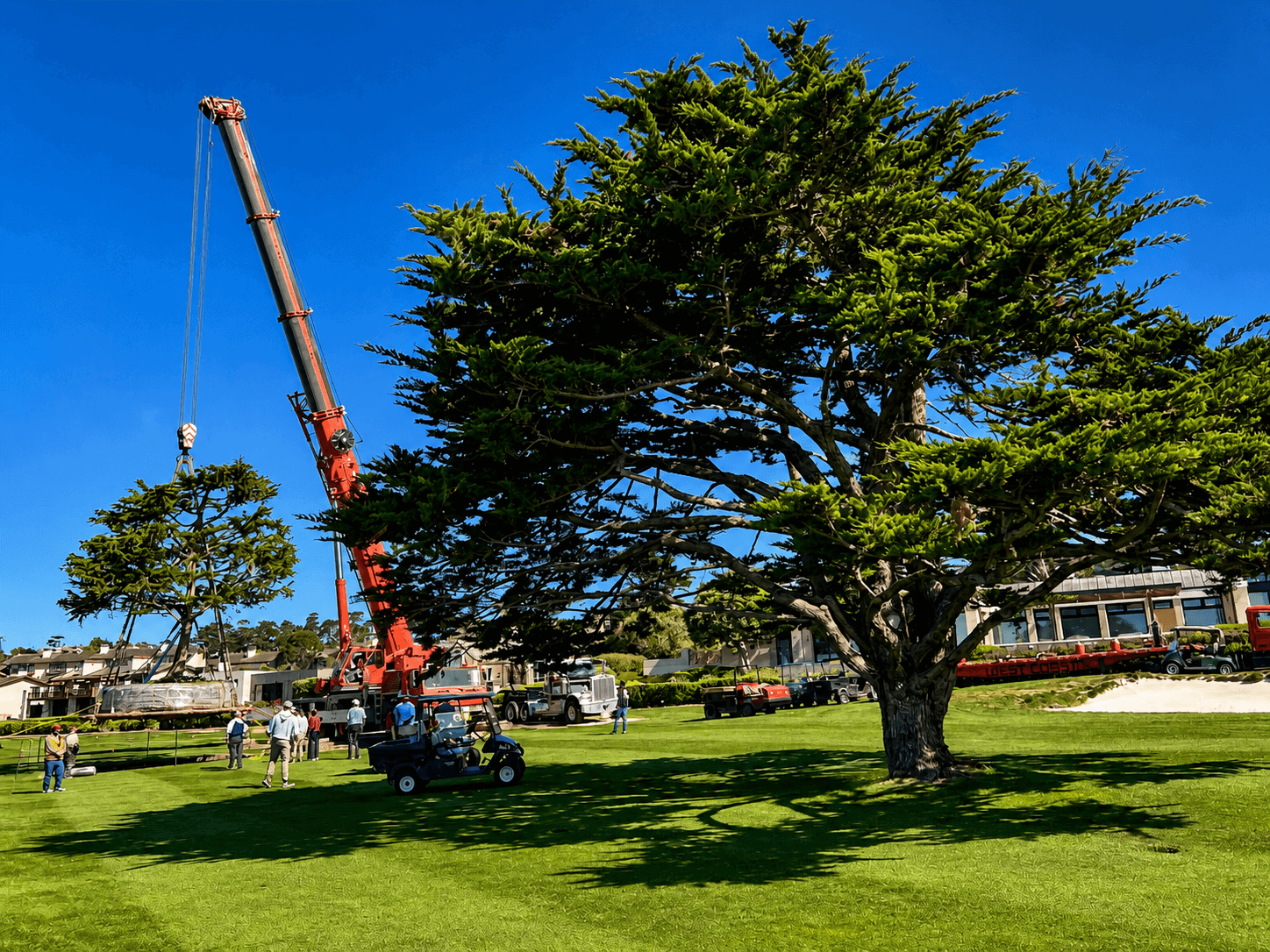
There is a cypress tree standing at the edge of the 18th hole at Pebble Beach Golf Links. It is one of the most photographed trees in sports. It has shaped the outcome of U.S. Opens, AT&T Pro-Ams, and Sunday rounds for decades. Players have stared it down. Cameras have framed it against the Pacific at dusk. To most people watching from home, it has simply always been there.
It was not always there. And it did not get there on its own.
Environmental Design, Inc. moved it. The story of how that happened is one of the most technically demanding, logistically complex, and quietly consequential projects in the history of golf course preservation. It is a story that spans more than two decades, involves a 200-year-old tree, a course that never closed for a single day, and a long-running relationship between EDI and one of the most iconic venues in all of sports.
And in April 2026, that story gained a new chapter, covered by Golf Digest and Golfweek, as Pebble Beach prepared to host the 2027 U.S. Open.
The 18th Hole and the Tree That Defined It
A Finishing Hole Unlike Any Other
The 18th at Pebble Beach is a par-5 that runs along the Pacific Ocean on the left, with a crescent-shaped fairway and a green tucked against the sea wall. It is one of the most televised holes in golf, a backdrop for legendary finishes, dramatic collapses, and moments that have defined careers. The physical beauty of the hole is unmatched in American golf.
But beauty alone does not make a great hole. Strategy does. And for most of the course’s history, the strategy of the 18th was shaped in large part by the tree standing near its green.
When the Original Tree Was Lost
Since Pebble Beach opened in 1919, the 18th green had been guarded by a massive Monterey Pine. The tree was not just scenery. It was a decision point. Its limbs hung over the corridor to the green, forcing every golfer who reached the fairway in position to consider: commit to the green and risk the ocean on the left, or lay up short and accept the pressure of a precise wedge approach. That choice had defined the hole for generations.
When the pine finally succumbed to pitch canker disease, the hole changed. The visual anchor was gone. The overhanging presence that had framed millions of approach shots simply disappeared. The 18th at Pebble Beach, one of the most celebrated finishing holes in the world, had lost something no renovation budget could easily replace.
The Pebble Beach Company came to Environmental Design with a question that most people in the tree industry would have considered outside the realm of possibility: could a replacement tree be found and moved that would genuinely restore what the hole had lost?
EDI’s answer was yes. It would require six months of preparation, five days of careful execution, and a project plan with no room for error. But it could be done.
Finding a 200-Year-Old Tree in the Right Place
The Search Through Del Monte Forest
EDI’s project engineer began a careful search through the Del Monte Forest, studying trees for months to find one with the right size, canopy structure, and visual profile to credibly replace what had stood at the 18th for decades. Moving a tree from a significant distance introduces compounding risk at every stage of the process. The closer the source tree, the better the odds of a successful transplant.
The answer was already on the course. A 200-year-old Monterey Cypress stood on the side of Pebble Beach’s first fairway. Its height, canopy spread, and overall character made it the right candidate. Its location on the same property meant the transplant could be executed without the logistical complications of off-site sourcing. Most importantly, it meant the tree had spent two centuries acclimating to the specific climate, soil, and maritime conditions of Pebble Beach itself.
Why the Monterey Cypress Was the Right Choice
Monterey Cypress trees are native to the California coast and are among the most visually dramatic trees in the world when mature. Their sculptural, wind-shaped canopies have become synonymous with the Monterey Peninsula landscape, which is part of what makes them so integral to the character of Pebble Beach. Replacing the original Monterey Pine with a Monterey Cypress was not just a practical decision. It was a more durable one. Cypress trees are more resistant to pitch canker disease and better suited to long-term survival in that coastal environment.
The selected tree was also significant in its age. At 200 years old, it had the maturity and scale to immediately restore the visual presence the 18th hole needed. There would be no waiting decades for a young tree to grow into the role. This tree was already what the hole required.
Six Months of Preparation Before the Tree Moved an Inch
Large tree relocation is not an event. It is a process. And the preparation phase is where every successful transplant is really won or lost. EDI’s six-month preparation program for the Pebble Beach cypress was methodical, layered, and built around a single goal: giving the tree the best possible chance of long-term survival in its new location.
Root Pruning
Root pruning is the foundation of any successful large tree transplant. By systematically severing the outer roots over a period of months, EDI encouraged the tree to develop a compact, fibrous inner root system concentrated within the zone that would be lifted and moved. This process redirects the tree’s energy and creates the kind of root structure that can survive excavation, transport, and replanting without catastrophic shock.
For a 200-year-old specimen, this process required patience. The root system of a tree this age is vast and deeply established. Rushing it would have compromised the outcome. EDI’s team monitored the tree’s response throughout the pruning process, adjusting the program based on how the tree was responding and ensuring it remained healthy and viable through every stage.
Root Ball Encapsulation
Once the root pruning phase was complete, the root ball was carefully encapsulated to hold its structure during the excavation and transport process. A tree of this age and size carries significant weight in its root system alone. The encapsulation needed to maintain the integrity of the root ball from the moment it left the ground through final placement at the 18th green, preventing fractures or collapse that could fatally stress the tree.
Site Preparation at the Destination
While the tree was being conditioned for relocation, EDI’s team worked in parallel to prepare the destination site at the 18th green. Soil composition was studied and modified where necessary. Drainage was planned. Structural support systems were designed and staged. The goal was to have a receiving site ready to accept the tree immediately upon arrival, minimizing the time it would spend in a transitional state between its original location and its permanent new home.
ArborLift® Platform Installation
In the final phase of preparation, EDI installed its patented ArborLift® system beneath the root ball. The ArborLift® uses large inflatable pneumatic platforms to lift a tree with even, distributed pressure across the root mass, rather than concentrating force at a small number of contact points. This proprietary technology was developed specifically for trees of this scale and represents one of the most significant innovations in large tree relocation in the past four decades.
For the Pebble Beach project, the ArborLift® system was essential. A tree of this age and weight could not simply be lifted by conventional crane and rigging without risking catastrophic damage to the root structure. The pneumatic platform approach allowed for gradual, controlled elevation that protected the root ball’s integrity from the first inch of lift through the full height of clearance needed for transport.
The Move: Five Days Across an Open Golf Course
Building the Road
Moving a tree of this scale across a golf course required constructing a temporary roadway capable of supporting the weight of the tree, its root ball, and the heavy equipment needed to propel it forward. More than 50 Pebble Beach employees worked alongside EDI’s team, laying sheets of plywood across the fairways and flipping them forward as the tree passed, like cards being turned over one by one.
The route took the tree across the first, second, third, and eighteenth fairways. A 500-horsepower tractor, a semi-tractor, and a forklift provided the power. The speed was measured in feet per hour. This was not a move that could be rushed. Every step of the journey was planned, communicated, and executed with the understanding that any misstep could compromise the tree, the course, or both.
Golf Never Stopped
Throughout all five days of the transplant, golf operations at Pebble Beach continued without interruption. Players who had waited months and paid hundreds of dollars for the opportunity to play one of the most famous courses in the world teed off their rounds and found themselves watching one of the largest loose impediments in the history of the game slowly make its way across the fairways. Some paused their rounds to watch. Some photographed it. All of them witnessed something that had never been done at this scale on an open, operating golf course.
That the course never closed is itself a testament to the precision of EDI’s planning. The routing of the move, the timing of each phase, and the coordination with Pebble Beach’s operations team were all managed to ensure that the transplant was an extraordinary event without becoming a disruption. That balance is only achievable when the people executing the project have done this before, many times, at the highest level.
Placement, Orientation, and Final Installation
When the cypress reached the 18th green, the work of positioning it began. This was not simply a matter of lowering it into a hole. The orientation of the tree’s canopy, the angle of its lean, and its precise placement relative to the green and the approach corridor all had to be considered and confirmed before the final lowering. EDI’s team worked closely with Pebble Beach officials to ensure that the tree’s placement restored the visual and strategic character of the hole as closely as possible.
Once in position, the root ball was backfilled using soil sourced from the tree’s original location on the first fairway, giving it the best possible chemical and biological environment to establish in its new home. Support cables were secured to stabilize the tree during its initial establishment period. Bunkers that had been affected by the move were rebuilt. Turf that had been disturbed along the transport route was restored. Within six days of the transplant beginning, the hole had been transformed.
Post-Planting Care and Establishment
EDI’s involvement did not end once the tree was in the ground. A successful transplant requires sustained aftercare in the months and years following relocation. For the Pebble Beach cypress, this included customized irrigation protocols designed to support root establishment without oversaturation, ongoing root zone monitoring, and nutrient programs tailored to the tree’s specific condition and the coastal microclimate of its new location.
The goal was never simply to keep the tree alive. It was to allow it to thrive, to grow, and to become a permanent and self-sustaining part of the Pebble Beach landscape. That is what happened. The cypress now stands as the visual centerpiece of one of golf’s most famous holes, healthy, growing, and framing approach shots exactly as intended.
Why This Project Stands Apart
Not a Replacement. A Restoration.
There is an important distinction between planting a new tree and restoring a hole. New trees are planted at golf courses all the time. They take decades to grow into their intended role, and they often never fully recapture what was lost. The Pebble Beach project was not that. It was a restoration, executed with enough precision and scale that the hole was returned to its former character in a matter of days rather than generations.
That distinction matters to the players who compete there. It matters to the architects who designed and have maintained the course. It matters to the fans who watch U.S. Opens and AT&T Pro-Ams and who know the 18th hole by sight. And it matters to the Pebble Beach Company, which has a stewardship responsibility not just to the course as it exists today but to the legacy of what it has always been.
A 25-Year Relationship Built on Trust
The Pebble Beach transplant was not the first time Environmental Design had worked at this property. EDI’s relationship with Pebble Beach spans 25 years and dozens of individual projects. Over that time, the team has transplanted key trees on more than a dozen holes across the property, systematically replacing aging Monterey Pines with more resilient Monterey Cypress to preserve the visual character of the course for future generations.
That long-running partnership is what made the 18th hole project possible. Pebble Beach’s leadership already knew EDI’s capabilities. They understood what the team could accomplish with large specimen trees in difficult conditions. When the time came to restore the most visible and consequential tree on the most famous hole on the course, there was no question about who to call.
What It Means to Preserve a Golf Course’s Identity
Golf courses are not static objects. They are living landscapes that age, evolve, and face constant pressure from disease, storms, development, and time. The trees that define them, that frame their fairways and shape their strategy, are among the most valuable and most vulnerable elements of that landscape. When a significant tree is lost and simply left unreplaced, something of the course’s identity goes with it.
What Environmental Design does is give courses a different option. Instead of waiting for a sapling to mature over half a century, instead of accepting a permanent change to the character of a hole, courses can work with EDI to relocate mature specimens that immediately restore what was lost. The result is not a compromise. It is a continuation.
A New Chapter: The 2026 Transplant and the Road to the U.S. Open
A Tree Lost to a 2014 Storm
In December 2014, one of the most powerful storms in years swept through the Monterey Peninsula. Among the casualties was a second cypress tree in the 18th fairway at Pebble Beach, planted a decade earlier as a companion to the original EDI transplant. The winds that night were recorded at more than 40 miles per hour. The tree that had stood in the fairway, adding a secondary layer of strategic complexity to approach shots, came down and did not come back up.
For more than a decade, that gap in the fairway remained. Players and golf architecture observers who knew the hole in its fuller form recognized that something was missing from the strategic picture. The 18th still had its ocean, its seawall, and its iconic green-side cypress. But the layered challenge of the fairway had been diminished.
Restoring the Fairway Ahead of the 2027 U.S. Open
In April 2026, Pebble Beach made its move. A mature cypress from the 17th hole at nearby Spyglass Hill was relocated to the 18th fairway, placed approximately 30 yards farther down from the original cypress and slightly more to the right, a positioning that brings more strategic complexity into play for most players considering whether to go for the green in two.
The timing was deliberate. Pebble Beach is set to host the 2027 U.S. Open, and the course is in the midst of a broader effort to present itself at its absolute best for what will be one of the most-watched golf events in years. Restoring the 18th fairway to its fuller, more strategically layered state before the world’s best players arrive is exactly the kind of detail that separates the stewards of a great course from those who simply maintain one.
The Move That Caught the Golf World’s Attention
Pebble Beach announced the new addition on April 30, 2026, sharing photos of the freshly planted cypress on the 18th fairway. The response from the golf community was immediate. Social media lit up. Golf architecture forums and podcasts devoted segments to what the addition would mean for how the hole plays. And the sport’s most trusted publications covered the story in depth.
National Media Coverage: Golf Digest and Golfweek
Golf Digest: Restoring the Original Design Intent
Golf Digest, which ranks Pebble Beach ninth on its list of America’s 100 Greatest Golf Courses, covered the 2026 transplant and reported that the new cypress restores the hole to its original design intent. The publication noted the tree’s origin at Spyglass Hill, its placement in the fairway, and the strategic shift it introduces for players approaching the green. Golf Digest also traced the history of the hole’s tree, connecting the original pine, the first cypress transplant, the 2014 storm, and the 2026 restoration into a single narrative of ongoing stewardship.
Being covered by Golf Digest in this context is not incidental. This is the publication that defines the standard for golf course quality in America. When it devotes editorial attention to the planting of a single tree at Pebble Beach, it is acknowledging that the tree matters, that the hole’s character matters, and that the work of preserving that character is worthy of recognition.
Golfweek: Coverage Ahead of the U.S. Open
Golfweek, which ranks Pebble Beach among its Best Classic Courses, obtained images of the large crane lifting the cypress into its new position on the 18th fairway and broke the story ahead of Pebble Beach’s official announcement. Golfweek framed the transplant explicitly in the context of the 2027 U.S. Open preparations, noting that the course was actively working to restore and enhance its landscape before hosting one of the sport’s premier championships. A Pebble Beach caddie told Golfweek he had noticed a freshly dug hole on the 18th on Monday and a large tree resting on pipes at Spyglass Hill earlier that week, connecting the dots before the announcement came.
The coverage from both publications reflects something important about the nature of this work. Moving a tree is not a story that most media outlets cover. When Golf Digest and Golfweek both devote space to a single transplant at a golf course, they are communicating to their readership that this is a meaningful event, one that will affect how the hole plays and how the course presents itself on the largest stages.
What the Attention Means
Golf architecture has a devoted and knowledgeable audience. The readers who follow Golf Digest and Golfweek are not casual observers. They understand the relationship between landscape and strategy. They know why a tree in a specific position on a specific hole changes the way the hole is played and experienced. When they read about the restoration of the Pebble Beach 18th, they understand immediately why it matters.
For Environmental Design, this kind of coverage is a reflection of the quality of the work and the significance of the clients who trust EDI to do it. Pebble Beach does not take shortcuts. It does not work with vendors who cannot deliver at the highest level. The fact that the golf world’s most respected publications are covering the trees at Pebble Beach is a direct testament to the standard of work that has been done there for more than two decades.
Environmental Design and the Legacy of Pebble Beach
Part of One of Golf’s Greatest Courses
Pebble Beach Golf Links is ranked among the greatest golf courses in the world by every major publication that covers the sport. It has hosted six U.S. Opens, multiple AT&T Pro-Ams, and has been the setting for some of the most memorable moments in golf history. The landscape that frames those moments, the cypress trees silhouetted against the Pacific, the fairways carved along the cliffs, the 18th green visible from half a mile away, is as much a part of the course’s greatness as its routing and its conditioning.
Environmental Design has been part of maintaining and restoring that landscape for 25 years. That is not a small thing. The trees that players walk past, that cameras frame, that fans recognize instantly from photographs are in some cases trees that EDI found, prepared, moved, and planted. EDI’s fingerprints are on the visual character of one of the most photographed sporting venues in the world.
The Standard That Drives Every Project
Pebble Beach is one of many high-profile venues in EDI’s project portfolio. The company has worked at Augusta National, Cypress Point, Spyglass Hill, TPC Sawgrass, and dozens of other courses that appear on Golf Digest’s Top 100 list. In each case, the expectation is the same: the work must be right. The trees must survive and thrive. The course must continue operating. And the result must honor the landscape and legacy of the venue it is serving.
That standard is not something EDI imposes on itself from the outside. It comes from more than four decades of doing this work at places where mistakes are not an option. It comes from proprietary technology developed specifically to address the challenges of moving large, mature specimens safely. And it comes from a team of specialists who understand that a tree is not an object to be moved from point A to point B. It is a living system, with its own biology, its own history, and its own relationship to the environment it came from and the environment it is going to.
Have a Project That Requires This Level of Expertise?
Whether you are managing a world-class golf course, a major development, a historic estate, or any landscape where a mature tree needs to move, Environmental Design has the experience, the technology, and the track record to make it possible. With over 40 years of large tree relocation experience, a client list that includes some of the most respected venues in sports and architecture, and patented ArborLift® technology that no other firm can offer, EDI brings a standard of capability to every project that is genuinely without equal.
The 18th hole at Pebble Beach looks the way it does because the right team was trusted to do the right work at the right time. That same commitment is available to every client who reaches out to EDI with a project that matters.
Explore our full project portfolio or contact us to tell us about your project.
Let’s talk about what EDI can do for you.

Recent Comments