
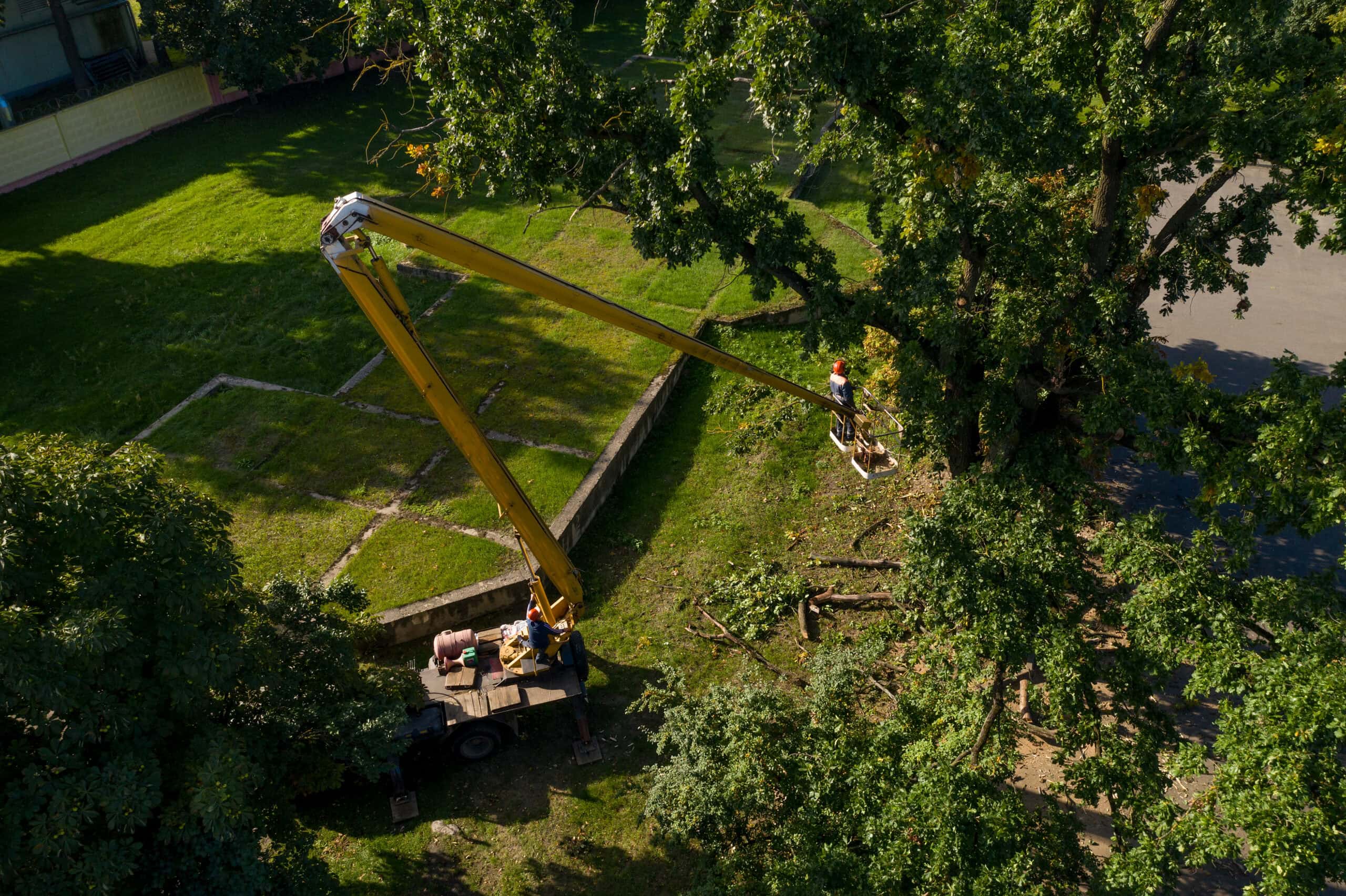
Moving a mature tree is not simply a matter of having large equipment and willing crews. It requires understanding how trees function biologically, how their root systems absorb and distribute the stress of excavation and transport, and how to lift and move something living without destroying the biological integrity that determines whether it survives in its new location.
For most of the history of tree relocation, the limiting factor was not motivation or even equipment size. It was the inability to lift a large root ball without concentrating force in ways that shattered the soil structure, tore feeder roots, and compromised the root mass that the tree would need to establish itself after the move. Environmental Design, Inc. developed the ArborLift® system specifically to solve that problem. The result was a patented technology that fundamentally changed what large-scale tree relocation could accomplish.
Why Conventional Tree Lifting Falls Short for Large Specimens
Before understanding what ArborLift® does, it is worth understanding why conventional lifting methods fall short for trees at the scale EDI regularly works with. Traditional approaches to lifting trees for relocation involve mechanical excavation to expose and shape the root ball, followed by lifting with crane or rigging equipment attached to the trunk or to a frame built around the root ball.
For small and medium trees, these methods work adequately. For specimen trees that have been growing for decades and may weigh tens of thousands of pounds, the physics of conventional lifting create serious problems. When a root ball of that size and weight is lifted using rigging concentrated at specific attachment points, force is distributed unevenly across the root mass. The result is compressive stress at some points and tensile stress at others, both of which can fracture the soil structure that holds fine feeder roots in their functional position within the root ball.
This kind of root damage is not always immediately visible. The tree may be lifted, transported, and planted without apparent problems, only to decline in the months following transplanting as the extent of root damage becomes apparent through reduced water and nutrient uptake. Survival rates for large trees moved with conventional methods have historically been significantly lower than those achieved with the ArborLift® system.
What ArborLift® Does Differently
The ArborLift® system uses large pneumatic inflatable platforms positioned beneath the root ball to distribute lifting force evenly across the entire base of the root mass. Rather than concentrating force at specific attachment points, the system creates a continuous, cushioned support surface that conforms to the shape of the root ball and lifts it with distributed, gentle pressure that protects root integrity throughout the lift.
Full-Surface Contact and Even Distribution
The pneumatic design allows the ArborLift® platforms to conform to the irregular contours of a root ball rather than bridging across it. A conventional lifting platform makes contact at its edges and corners, leaving the center of the root ball unsupported and subject to internal stress when the full weight of the tree is concentrated at those contact points. The ArborLift® system maintains contact across the full surface, distributing the tree’s weight as evenly as the biology of the root ball allows.
Controlled Inflation and Gradual Lift
The inflation of the ArborLift® platforms can be managed precisely throughout the lift, allowing the tree to be raised gradually rather than with the sudden application of force that conventional mechanical lifting requires. Gradual, controlled lifting reduces mechanical shock to the root system, allows soil within the root ball to remain stable rather than shifting, and gives the tree’s structure time to redistribute internal stresses as the lift progresses.
Cushioning During Transport
Once the tree is lifted and loaded for transport, the pneumatic platforms continue to function as cushioning that absorbs vibration and surface irregularity during movement. Moving a large tree across a construction site, a golf course, or a developed property involves traversing ground that is rarely perfectly smooth. The ArborLift® system absorbs that movement rather than transmitting it directly to the root mass, reducing the cumulative mechanical stress that transport imposes on the root system.
The Projects That Made This Technology Necessary
ArborLift® technology was not developed in a laboratory. It was developed in response to the demands of real projects where conventional methods were inadequate. EDI’s work at Pebble Beach Golf Links, which involved relocating a 200-year-old Monterey Cypress from the first fairway to the 18th hole, represents one of the most technically demanding tree relocations ever attempted. The scale, the age of the tree, and the expectation that the cypress would thrive for decades in its new location, not merely survive the move, required a lifting system that could protect a root ball of that size and weight without compromise.
The success of that transplant, and of subsequent large-scale projects at Augusta National, TPC Sawgrass, and dozens of other high-profile venues, validated the ArborLift® approach and established the system as the defining technical capability that separates EDI from every other tree relocation company in the industry.
ArborLift® as Part of a Complete System
It is worth being precise about what ArborLift® is and what it is not. It is the mechanical innovation at the center of a complete tree relocation process, not the entire process itself. The technology enables the lift phase of a transplant to be performed without compromising root integrity. It does not eliminate the need for the months of root pruning that precede the lift, the careful site preparation that must occur at the destination, or the establishment care program that determines long-term survival after planting.
EDI’s team of certified arborists and field specialists has developed and refined every phase of this complete process over more than four decades. ArborLift® is the innovation that makes the largest and most demanding projects achievable. The knowledge, preparation, and post-planting care that surrounds it are equally responsible for the outcomes that have made EDI the trusted partner of golf courses, developers, municipalities, and estate owners who need a tree relocation team that can deliver at the highest level.
What This Means for Property Owners and Developers
The practical implication of ArborLift® technology is that trees which would previously have been candidates for removal rather than relocation can now be successfully transplanted with high confidence of long-term survival. A mature oak that stands in the footprint of a new building can be relocated to a featured position on the finished site. A historic tree on a golf course that needs to move due to renovation can be saved rather than lost. A landscape architect’s vision can include trees at a scale and maturity that was previously not achievable through any means other than waiting decades for young trees to grow.
Contact us to learn more about ArborLift® technology and what it could make possible for your project.
Recent Comments