
Patented in 2014, ArborLift® is revolutionizing the giant tree transplanting industry. Utilization of this method often times eliminates the need for large hydraulic cranes and heavy-duty trailers/transporters as part of the tree relocation process which may reduce cost.
Contact UsView Our Work
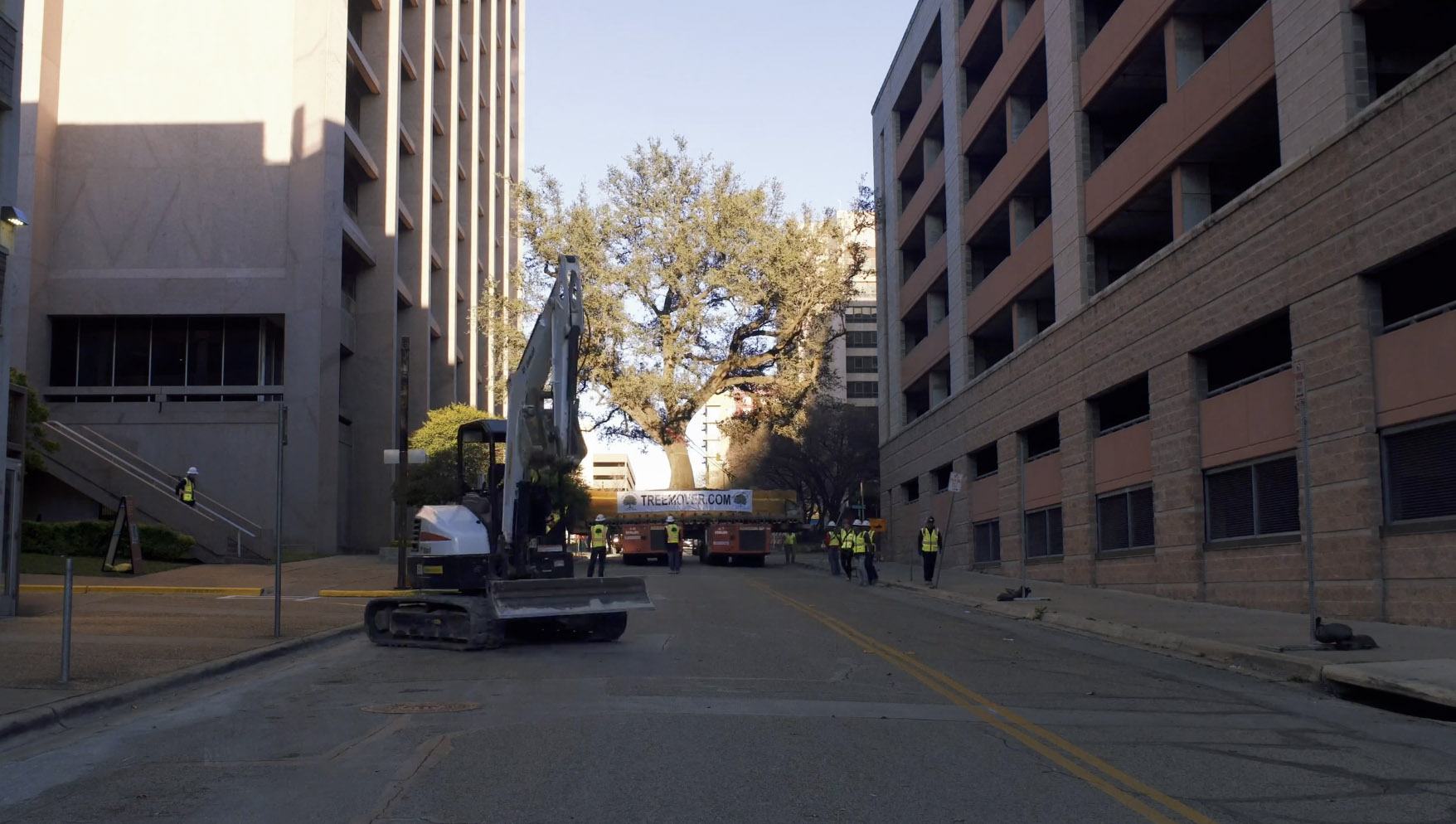
ArborLift® Is Tree Moving At Its Best
Through the employment of a series of inflated pneumatic bladders with extremely low ground bearing pressure installed beneath a rigid lifting platform, ArborLift® allows for the controlled rolling of giant trees over turf, concrete, and hardscape surfaces with minimal disturbance. Moreover, ArborLift® adds a safety component to giant tree transplanting not available when using cranes and or lifting gantries. ArborLift® also ensures root ball integrity by eliminating pipe platform deflection. Environmental Design, Inc. is currently utilizing ArborLift® throughout the United States and elsewhere. This method is often the best choice for tree moving projects in cities and municipalities with ordinances requiring the preservation and or relocation of heritage trees affected by new construction. This patented technology allows us to safely relocate trees with root balls in excess of 36′ in diameter with weights exceeding one million pounds.
Follow Us on Instagram
ArborLift FAQs
What is ArborLift tree moving technology, and how does ArborLift tree moving technology transform the relocation of large and mature trees?
ArborLift tree moving technology is an advanced, engineered system designed to relocate large and mature trees with greater precision, stability, and safety than traditional methods. ArborLift tree moving technology combines patented lifting mechanisms, structural supports, and crane integration to address the unique challenges of moving oversized trees that cannot be handled by conventional equipment.
At the core of this approach is the ArborLift system, which stabilizes the tree during lifting and transport by distributing weight evenly across the trunk and root ball. Unlike standard rigging methods that can place stress on limited contact points, the ArborLift tree moving method secures the tree within a reinforced framework. This reduces the risk of trunk damage, root ball shifting, or structural failure during ArborLift tree relocation.
Patented ArborLift movers are specifically designed to work with large tree transport technology, allowing for controlled vertical and horizontal movement. This is especially valuable when relocating trees in constrained environments such as developed sites, commercial campuses, or urban settings. ArborLift crane system integration enables ArborLift specialists to lift trees cleanly from the ground and place them precisely into transport or final planting locations.
Another defining advantage of ArborLift transplant equipment is adaptability. The system can be customized to accommodate different tree sizes, shapes, and weights, making it suitable for a wide range of environmental design applications. ArborLift service providers use this flexibility to relocate trees that would otherwise be considered too risky or impractical to move.
From an environmental design perspective, tree relocation with ArborLift allows projects to preserve mature canopy, visual character, and ecological function. By reducing physical stress on the tree and increasing control throughout the process, ArborLift tree moving technology improves survival rates and long-term performance. This makes it a foundational tool for projects where mature trees are central to design intent and sustainability goals.
Why do ArborLift tree moving technology and the ArborLift system offer advantages over traditional large tree transport technology?
ArborLift tree moving technology offers significant advantages over traditional large tree transport technology because it was engineered specifically to address the limitations of conventional lifting and rigging methods. ArborLift tree moving technology prioritizes structural stability, load distribution, and precision control, which are critical factors when relocating large or irregularly shaped trees.
Traditional approaches often rely on slings, straps, or improvised rigging that concentrate stress on limited areas of the trunk or root ball. The ArborLift system eliminates these weak points by creating a secure framework around the tree. Patented ArborLift movers cradle the tree and root mass, reducing movement during lifting and transport. This stability is especially important for tall trees, wide canopies, or species with brittle wood.
ArborLift crane system integration further differentiates this method. ArborLift specialists can lift trees vertically with minimal lateral stress, which is difficult to achieve using standard crane rigging alone. This controlled motion reduces shock to the root system and helps maintain soil integrity around the root ball, improving outcomes during ArborLift tree relocation.
Another advantage is predictability. ArborLift transplant equipment allows ArborLift service providers to plan lifts with precise weight calculations and balance points. This consistency reduces risk on complex sites and supports safer operations in commercial or urban environments. Tree relocation with ArborLift is particularly valuable when access is limited or when trees must be positioned accurately within tight design parameters.
For environmental design projects, these advantages translate into higher survival rates and better long-term performance. ArborLift tree moving technology makes it possible to preserve trees that contribute immediate shade, scale, and character. By outperforming traditional large tree transport technology, the ArborLift system expands what is achievable in mature tree preservation and relocation.
How does ArborLift tree moving technology support environmental design projects that require precision and minimal site disruption?
ArborLift tree moving technology supports environmental design projects by enabling precise tree relocation while minimizing disruption to surrounding landscapes and infrastructure. ArborLift tree moving technology was developed with the understanding that many modern sites require careful coordination between construction, design, and preservation efforts.
The ArborLift system allows ArborLift specialists to lift and move trees vertically, reducing the need for excessive excavation or wide staging areas. This precision is particularly valuable on developed sites where buildings, utilities, and hardscape are already in place. ArborLift tree relocation can be executed with smaller footprints than traditional methods, helping designers preserve adjacent features.
Patented ArborLift movers stabilize the tree throughout the process, which limits shifting and ground disturbance during transport. Large tree transport technology often requires additional bracing or corrective handling, but ArborLift transplant equipment keeps the tree balanced from lift to placement. ArborLift crane system coordination ensures smooth transitions without abrupt movements.
Environmental design projects often aim to retain mature trees as focal elements or functional components of outdoor spaces. Tree relocation with ArborLift allows these trees to be repositioned strategically to support circulation, shade, and visual hierarchy. ArborLift service providers work closely with designers to align relocation paths and final placement with design intent.
Minimal disruption also supports sustainability goals. Reduced soil compaction, limited root damage, and controlled equipment movement help preserve surrounding vegetation and site conditions. ArborLift tree moving technology enables environmental design teams to protect existing ecosystems while adapting sites for new uses.
By combining precision engineering with arboricultural expertise, ArborLift specialists deliver relocation solutions that respect both the tree and the broader landscape, making ArborLift a powerful tool for complex environmental design challenges.
What types of trees and project conditions are best suited for ArborLift tree moving technology?
ArborLift tree moving technology is best suited for relocating large, heavy, or structurally complex trees that require enhanced stability during lifting and transport. ArborLift tree moving technology excels in situations where traditional methods may introduce excessive risk or lack sufficient control.
Trees with substantial height, wide canopies, or dense root balls benefit from the ArborLift system. Patented ArborLift movers distribute weight evenly, making it possible to relocate trees that might otherwise be prone to trunk stress or root ball shifting. ArborLift transplant equipment is also well-suited for species with brittle wood or sensitive root structures.
Project conditions play an equally important role. ArborLift tree relocation is ideal for sites with limited access, tight clearances, or nearby infrastructure. The ArborLift crane system allows ArborLift specialists to maneuver trees precisely without extensive ground disturbance. This makes tree relocation with ArborLift particularly effective in urban, commercial, or institutional environments.
Environmental design projects involving heritage trees or signature landscape elements also benefit from ArborLift service providers. The added control and stability help protect trees with cultural, historical, or visual significance. ArborLift tree moving technology supports careful handling and accurate placement, which is critical for these high-value assets.
By accommodating both challenging trees and demanding site conditions, ArborLift tree moving technology expands the range of relocation possibilities. It allows designers and planners to preserve mature trees that define landscapes while adapting sites to modern needs.
How do ArborLift specialists ensure successful outcomes before, during, and after tree relocation with ArborLift?
ArborLift tree moving technology delivers successful outcomes through a comprehensive process that spans planning, execution, and post relocation care. ArborLift tree moving technology is most effective when implemented by experienced ArborLift specialists who understand both the equipment and the biology of large trees.
Before relocation, ArborLift service providers conduct detailed assessments of tree health, structure, and root systems. This evaluation determines whether ArborLift tree relocation is appropriate and how the ArborLift system should be configured. ArborLift transplant equipment is customized to match the size and shape of the tree, ensuring balanced lifting.
During the move, patented ArborLift movers secure the tree within a stable framework. ArborLift crane system coordination allows for controlled lifting, transport, and placement. ArborLift specialists monitor load balance and movement throughout the process, reducing stress and preventing damage. Tree relocation with ArborLift emphasizes smooth transitions rather than speed alone.
After placement, attention shifts to establishment. ArborLift service providers assist with proper positioning, backfilling, and stabilization. Soil conditions are adjusted to support recovery, and irrigation plans are tailored to the tree and site. Monitoring continues to ensure that the tree responds positively to relocation.
By integrating technology, expertise, and aftercare, ArborLift tree moving technology supports long-term tree health. This holistic approach allows environmental design projects to retain mature trees as thriving, functional elements of the landscape.
How does ArborLift tree moving technology improve safety for crews, properties, and surrounding landscapes during tree relocation projects?
ArborLift tree moving technology improves safety by providing controlled, engineered support for large trees throughout the entire relocation process. ArborLift tree moving technology was designed to reduce unpredictable movement, uneven load distribution, and structural stress that can create hazards for crews, nearby properties, and surrounding landscapes.
The ArborLift system secures the tree within a rigid framework, minimizing sway and rotation during lifting. Patented ArborLift movers distribute weight evenly across the trunk and root ball, which lowers the risk of sudden shifts that can occur with traditional rigging. This stability is especially important when working near buildings, utilities, or pedestrian areas.
ArborLift crane system integration allows ArborLift specialists to lift trees vertically with precision. Controlled lifts reduce lateral forces that can destabilize cranes or damage adjacent structures. ArborLift transplant equipment also minimizes the need for manual adjustments during the move, lowering exposure for crew members.
Tree relocation with ArborLift supports safer site management. Smaller work zones, predictable movement paths, and reduced ground disturbance help protect existing landscapes and hardscapes. ArborLift service providers coordinate closely with project managers to maintain clear safety protocols throughout operations.
By engineering safety into the relocation process, ArborLift tree moving technology protects people, property, and the trees themselves, making it a trusted solution for complex environmental design projects.
How does ArborLift tree moving technology support the relocation of heritage and landmark trees with high preservation requirements?
ArborLift tree moving technology supports heritage preservation by providing the stability and precision required to relocate high-value landmark trees. ArborLift tree moving technology is particularly well-suited for trees with cultural, historical, or visual significance where failure is not an acceptable outcome.
Heritage trees often have irregular structures, large canopies, or extensive root systems. The ArborLift system accommodates these complexities by stabilizing the tree within a customized framework. Patented ArborLift movers reduce stress on vulnerable trunk sections and help protect critical roots during ArborLift tree relocation.
Precision placement is another key advantage. ArborLift crane system control allows ArborLift specialists to position heritage trees exactly where planners and preservation authorities require. Tree relocation with ArborLift minimizes unnecessary movement and ground disturbance, which is essential for maintaining surrounding historic landscapes.
ArborLift service providers also support documentation and compliance needs. Detailed planning, controlled execution, and post-relocation monitoring align with preservation standards often associated with heritage tree relocation. ArborLift transplant equipment enables repeatable, transparent processes that stakeholders can trust.
By combining advanced technology with careful handling, ArborLift tree moving technology allows heritage trees to remain living symbols within evolving landscapes, supporting both preservation goals and modern environmental design.
In what ways does ArborLift tree moving technology enhance efficiency and predictability for large-scale environmental design projects?
ArborLift tree moving technology enhances efficiency by streamlining large tree relocation into a controlled, repeatable process. ArborLift tree moving technology reduces variability that can delay schedules or increase risk on complex environmental design projects.
The ArborLift system allows ArborLift specialists to plan lifts with precise weight calculations and balance points. Patented ArborLift movers provide consistent support, which simplifies coordination between equipment operators and site teams. This predictability improves scheduling and reduces downtime during ArborLift tree relocation.
Large tree transport technology often requires extensive adjustments in the field, but ArborLift transplant equipment is configured in advance to match the tree and site conditions. ArborLift crane system integration further improves efficiency by enabling smooth transitions from extraction to transport to placement.
For multi-phase or multi-site projects, ArborLift service providers deliver consistent outcomes. Tree relocation with ArborLift allows designers and developers to rely on repeatable performance across locations, supporting broader environmental design strategies.
By reducing uncertainty and improving execution speed without compromising care, ArborLift tree moving technology helps projects stay on schedule while preserving mature landscape elements.
How does ArborLift tree moving technology contribute to sustainability and long-term environmental performance?
ArborLift tree moving technology contributes to sustainability by enabling the preservation of mature trees that deliver immediate environmental benefits. ArborLift tree moving technology supports a retain and adapt approach that aligns with responsible environmental design.
Mature trees relocated using the ArborLift system continue to provide shade, carbon sequestration, and habitat without the long establishment period required for new plantings. Tree relocation with ArborLift reduces the environmental impact associated with tree removal, disposal, and replacement.
ArborLift transplant equipment also minimizes soil disruption and root damage, which supports faster recovery and long term health. Patented ArborLift movers help maintain root ball integrity, improving survival rates and long-term performance.
For organizations focused on sustainability goals, ArborLift service providers offer a practical way to demonstrate stewardship. ArborLift tree relocation aligns with environmental commitments by preserving living assets rather than replacing them.
By protecting mature trees and reducing waste, ArborLift tree moving technology supports resilient landscapes that continue delivering ecological value for decades.
When should project teams engage ArborLift specialists to maximize the benefits of ArborLift tree moving technology?
ArborLift tree moving technology delivers the greatest value when ArborLift specialists are engaged early in the planning process. ArborLift tree moving technology is most effective when tree relocation is considered during conceptual design rather than after site constraints are finalized.
Early involvement allows ArborLift service providers to assess tree viability, recommend relocation strategies, and influence layout decisions. ArborLift specialists help designers understand spacing, access, and sequencing requirements that support successful ArborLift tree relocation.
When engaged late, opportunities may be limited by grading, utilities, or construction timelines. Tree relocation with ArborLift benefits from alignment with seasonal timing and project phasing, which is easier to achieve with early coordination.
ArborLift crane system planning also improves when specialists are involved upfront. This ensures proper access and safe lift paths without last-minute adjustments. ArborLift transplant equipment can be configured to suit project-specific conditions.
By engaging ArborLift specialists early, project teams reduce risk, control costs, and unlock the full potential of ArborLift tree moving technology as a core component of environmental design.